
The designer's identity shift
As AI rapidly enters every part of our professional and private lives, designers face a challenge where design must be redefined — and fast, because AI is coming in hot!

TL;DR
AI is changing the role of designers faster than ever before. Some creatives embrace it; others fear it. Both reactions are valid. But as AI takes over execution, designers must evolve from makers to directors - focusing on strategy, taste, and judgment. The future of design isn’t less human; it’s more human, guided by designers who understand how to combine creativity, technology, and context.
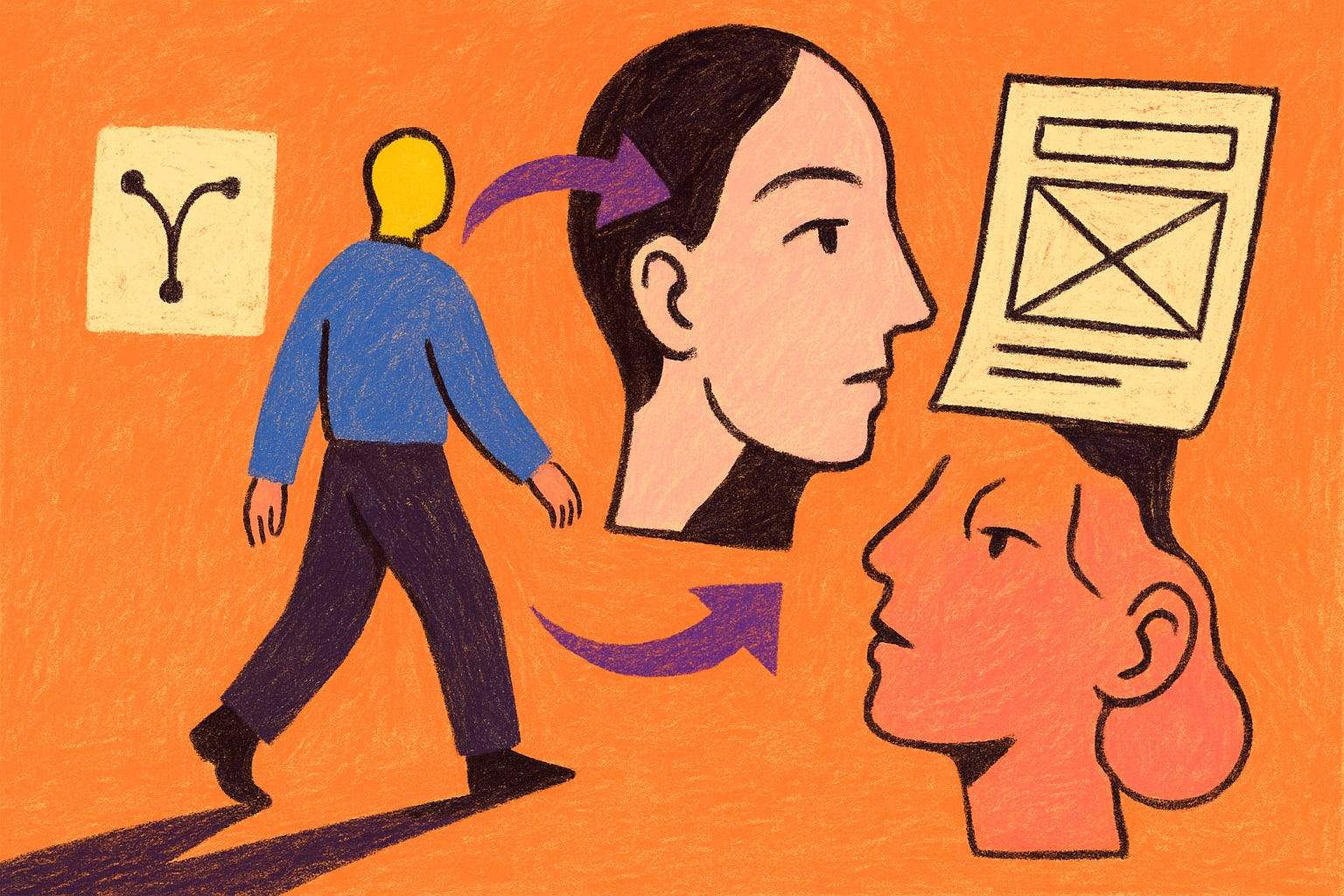
As a design consultant and AI specialist, I meet many designers, creatives, business leaders, and managers. And the verdict is clear: design is becoming much more difficult to sell and argue the value of.
Designers often react to AI implementation in two ways — with enthusiasm or with skepticism.
The AI enthusiasts
Some designers started using AI early on, jumping on every new tool they find. They keep a few, but most are discarded because the quality doesn’t meet their standards or the tools make fine-tuning impossible. Think of Midjourney, where a small request for detail can unexpectedly change the entire image.
The AI skeptics
Other designers see AI as an immediate threat to their jobs. Some have experience and can see how good certain results can be and worry their role may soon become obsolete, while others have little to no hands-on experience and see AI as a threat to the design craft, creativity, and originality as the primary concern.
Both perspectives are valid because almost no one can keep up with the speed of AI development. Even I, who work with AI full-time, am reminded of this daily.
But regardless of how good AI becomes, we can never make good design without a designer.
From execution to direction
As designers, we must start adjusting our perspective, role, and identity - from being designers and executors of design toward becoming design instructors, decision-makers, and judges. Our taste, understanding of context and payoffs, and the ability to make recommendations will play an even bigger part in our future design roles. They already play a significant part in many designers’ work today, but they are often overlooked or not understood as part of the design discipline.
When we start to talk about designers in terms closer to strategy, the value becomes more obvious.
This is not an easy task for many designers, though. When you are not used to verbalizing how you create value in relation to a strategy, it requires new skills, practice, and a solid framework - until it becomes second nature and part of how we communicate design’s true impact.
AI cannot replace the creative team
This article is part of a series that explores how designers and creatives can navigate the changes that come with AI. The designer’s identity shift is the first piece and the next couple of articles will explore more about why designer might resist AI, why the value of their work is difficult to communicate and how they can work in sync with the company strategy as lastly, a work kit that step-by-steps help designers through this AI shift.
The human advantage
Today we see firsthand how design jobs are becoming scarcer, design is less sought after, and designers must, to a much higher degree, argue why they still matter. If design was difficult to see the value of before, AI is now just amplifying that with the speed of light.
But human designers still have an essential advantage in context, responsibility and empathy. Because AI cannot give itself instructions based on something that just happened or was discussed at the coffee machine. It cannot own decisions or be accountable for the outcome. AI cannot read between the lines and sense the user’s or the client teams’ emotional state or pick up on subtle preferences or personal cues.
You can, of course, argue that most of the things on the list here can actually be performed and handled by AI. And yes, I agree. But only through human training, setup and supervision and in such a complex system that the system itself would likely evolve before the setup was complete.
Even then, humans will remain better at human-to-human understanding and relationship building. And isn’t that what design is ultimately about - understanding people, building relationships and designing outcomes that help the very same?
Human 3 weeks, AI 3 min
I was recently shown a tool that could build website wireframes in just three minutes, and the wireframes looked a lot better than anything I could have done (I used to work in UX design). Everything was perfectly positioned, every button state was accounted for, and it was insanely impressive to see the program build an entire website in detail in front of our eyes in just three minutes.
The demonstration prompted the question:
“Why do we use so much time in the UX process when AI can do it this fast?”
It’s a fair question - for someone with no UX design experience. But every UX designer knows that wireframes are just the output, and not the work.
“Building wireframes isn’t what takes time. Understanding the client’s business, processes, values, and strategy - and translating that into meaningful and strategic design - that’s what takes time. And that’s something that this tool isn’t solving” I answered.
Designers + AI = ❤️
But that does not mean that designers cannot benefit from AI. They definitely can. But tools are only powerful in skilled hands. A design tool without a designer is like a laptop that no one turns on or like an excel sheet used for designing website. It’s useless.
I am a huge fan of AI, and thrilled by how many of my tedious tasks it has reduced or entirely removed.
Our focus should be to find ways where we can use AI tools as tools. And then we can focus on the human centered part of the design work, where intuition, empathy and strategic thinking makes a difference to the products and to the people who will use and own our designs.
The role of the designer is not disappearing, but it is evolving - just as it and we should.
So what now?
Now we must start practice speaking about design in a different way. We must create a narrative where design is not dead and designers are not doomed, but where designers with AI tools play a key role in the companies strategic plan. One where the designer designs and the tool is a tool.
Thank you for reading!
There are more ways you can show your support:
❤️ Tapping the heart below helps my content get discovered
📧 Forward this to a friend
🌟 Become a subscriber if you are not already
About the author
I work at the intersection of strategy, communication, and technology, helping companies turn AI from an abstract idea into a practical tool that drives real results.
As a Senior System Designer and AI Adoption Specialist, I focus on making AI approachable — not just through strategy decks, but through everyday use.
On this Substack, I share insights, examples, and reflections from real projects: what works, what doesn’t, and how AI can enhance creativity and collaboration without losing the human touch.